
The Ghost in the Archives
Read Grace Leksana’s research article “Heroes of Production: Agricultural Science, the Indonesian Peasants’ Movement, and Knowledge Decolonization, 1950–1965” here.
Grace Leksana
Utrecht University
I suspect a lot of historians have encountered ‘the ghost’ in the archives. I am not referring to some mystical spirit flying around in an archive center, but a feeling of being haunted by a historical figure, place or event that we’ve encountered while reading certain archive material — an eerie feeling that never goes away, even once we’ve moved on to a different archival institute or when the research itself is over. For me, this ghost was Jagus.
My first encounter with Jagus occurred while I was reading through Pembangun Desa, a periodical from the Indonesian Peasants’ Front (Barisan Tani Indonesia — BTI), a leftist farmers’ organization from the decolonial period of the 1950s and 1960s. I had never heard his name, and knew nothing of him. But, as I went through eighteen editions of Pembangun Desa, Jagus kept on appearing, either through his own research writing, in consultation rubrics, or in blurry photo captions. His ghost started to haunt me: why had we never heard of him? He was considered (at least in the periodical) as one of the most influential rice researchers of his age, though we had also never heard of any of his rice varieties.
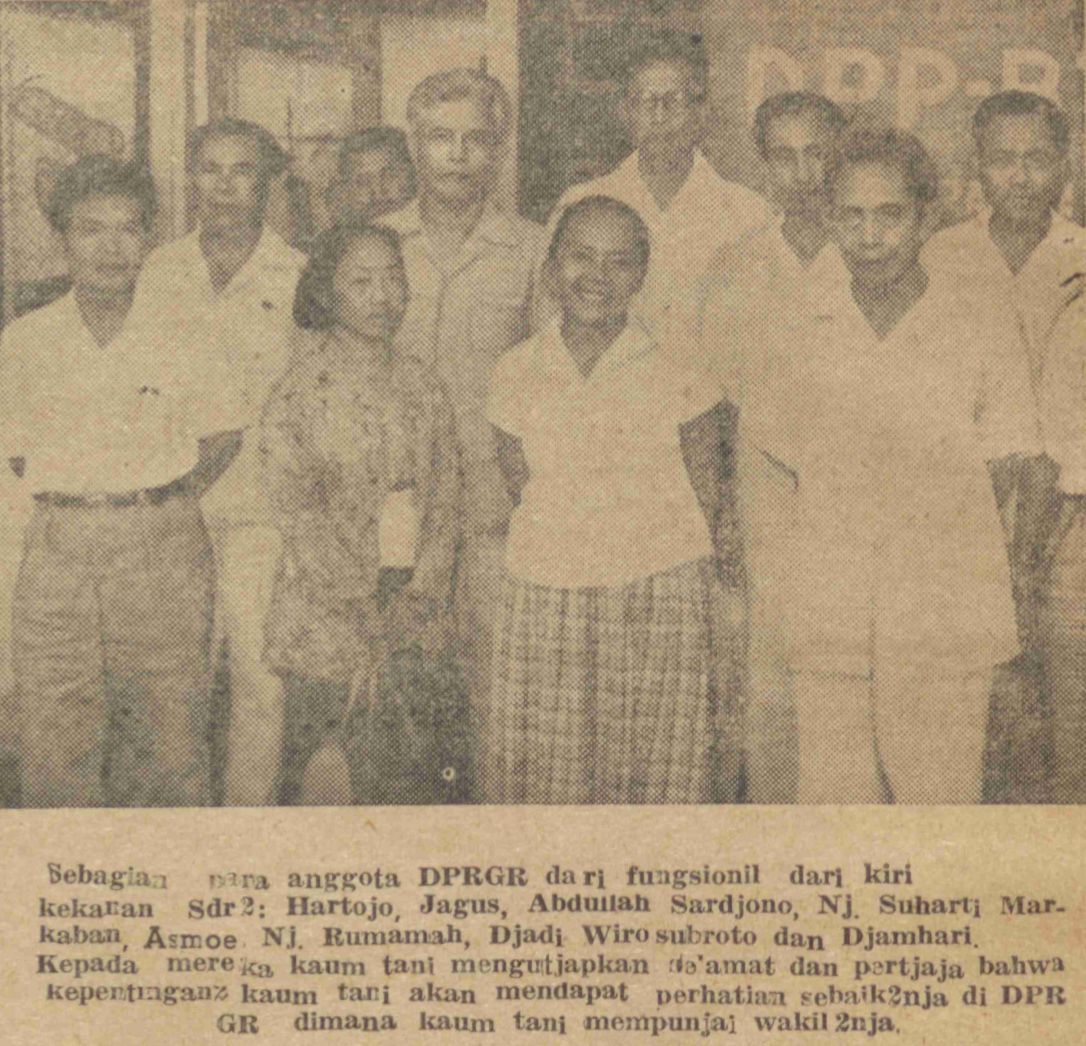
A photo featuring Jagus (second from left) in Suara Tani, May 1960. The photo caption (translated from Indonesian) states: ‘Some members of the People’s Representative Council (DPRGR), from left to right: Hartojo, Jagus, Abdullah Sardjono, Mrs. Suharti Markaban, Asmoe, Mrs. Rumamah, Djadi Wirosubroto and Djamhari. To them, the peasants send their congratulations and believe that the agendas of the peasants will be discussed thoroughly in the parliament.’ National Library of Indonesia.
As he was in a BTI periodical, I assumed Jagus must have been a leftist. Studying leftist histories in Indonesia is challenging and requires a lot of patience. A failed coup attempt in 1965 became a pretext to blame the Indonesian Communist Party (PKI) and other leftist organizations as the actors behind efforts to destabilize the nation. A national regulation released in 1966 by the authoritarian government of Suharto stated that the Indonesian Communist Party was an illegal organization and banned all teachings of Communism/Marxism and Leninism. Members of leftist organizations were killed or imprisoned and, when they were released, had to endure prolonged stigma resulting from the government’s anti-communist propaganda.
Thus, for decades, we knew little of our leftist history as Indonesians. When the Indonesian Communist Party or other leftist organizations made it into the history textbooks, they were depicted as evil provocateurs. Their various contributions towards the decolonial movement and pre-Independence nation building remain in the periphery, even in Indonesia’s own national historiography.
This situation has resulted in restricted access to documents or archives from the leftist organizations, if such archives remain at all. Most documents were destroyed by the army in 1965-1966 during the anti-communist military operation, or by the raging masses. Nobody dared keep such documents, and families burned their own copies, photos and other possessions — anything that could tie them to the communists. Only limited archives exist. The Indonesian National Archive, for example, only opened the KOTI (Highest Military Command Operation) archives in 2013 — a collection of confiscated documents from the Indonesian Communist Party and other leftist organizations. Last year, they also opened an inventory of the BTI (Indonesian Peasants’ Front), which was similarly purged in the anti-communist operation. Any other archive material is scattered across local archives, personal collections (from survivors or journalists) and oral accounts.
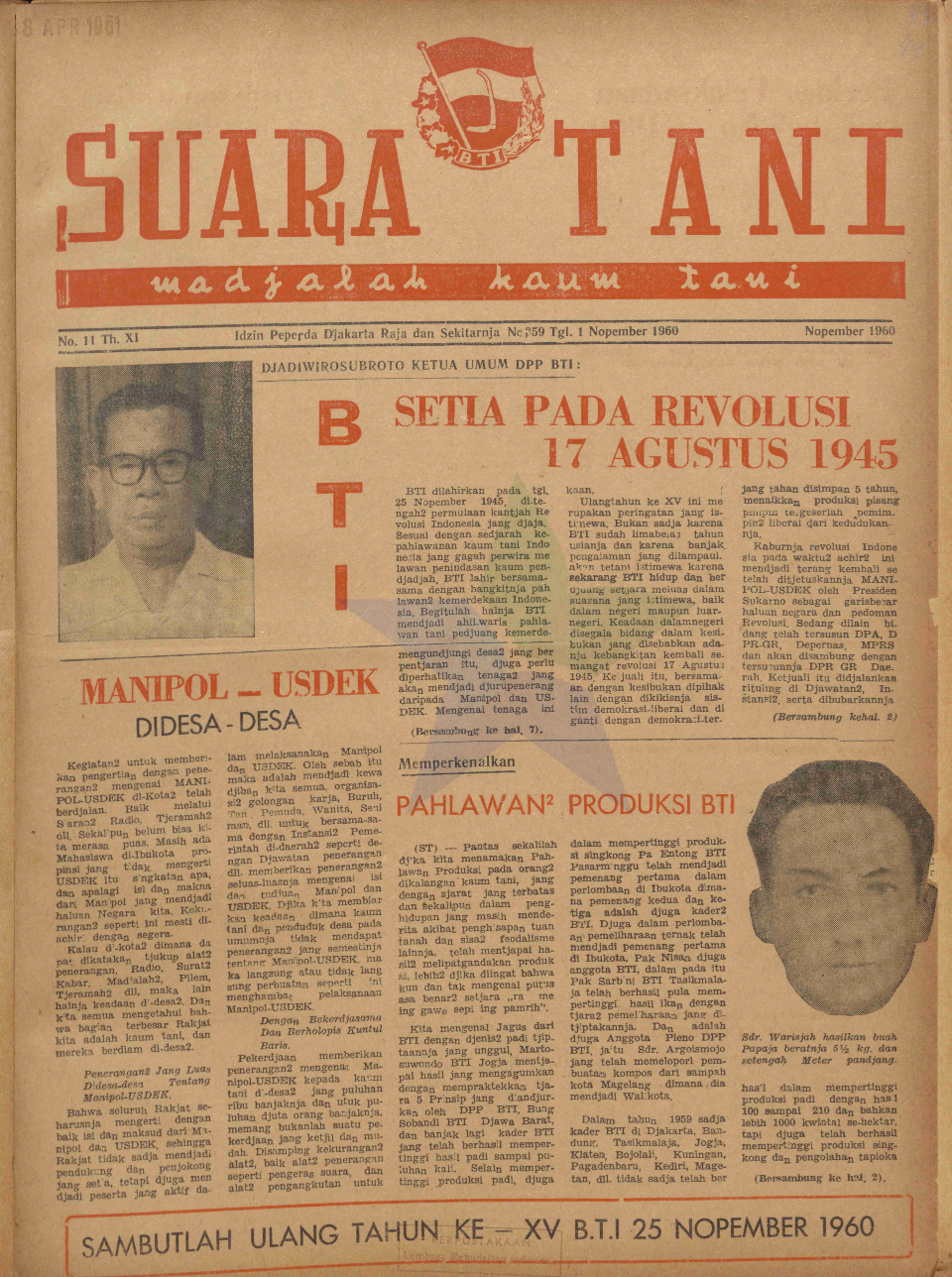
A page of Suara Tani (November 1960), with an article about ‘BTI’s heroes of production.’ National Library of Indonesia.
This was the daunting context I faced when I began my PhD research in Leiden in 2015. I was examining Pembangun Desa in the collection at Leiden University Library, trying to understand the movement, especially during the 1960s land reform era in East Java. While access to leftist archives in Indonesia itself remains limited, several foreign institutions hold such collections which are open to the public. And yet only a handful of Indonesians have the means and privilege to visit such institutions. Had I not been able to undertake my PhD at Leiden, I might never have learned about the BTI, nor encountered Jagus.
So what exactly happened to Jagus? I started asking around, mentioning him to colleagues, leftist survivors, even friends who I knew were born or lived in the same city as him — Klaten, in East Java. Being a historian is not only about sitting in dark rooms surrounded by dusty archives, but also being agile with people, since stories also live amongst them. Through this network of colleagues and friends, I finally managed to connect with Jagus’s own family, still living today in East Java. They are lovely and warm people, proud of Jagus and his work, but also heavily traumatized by how the Indonesian government treated him. Jagus was detained by the military in Klaten in 1965, but later released. He never returned to his agricultural research and died in 1975.
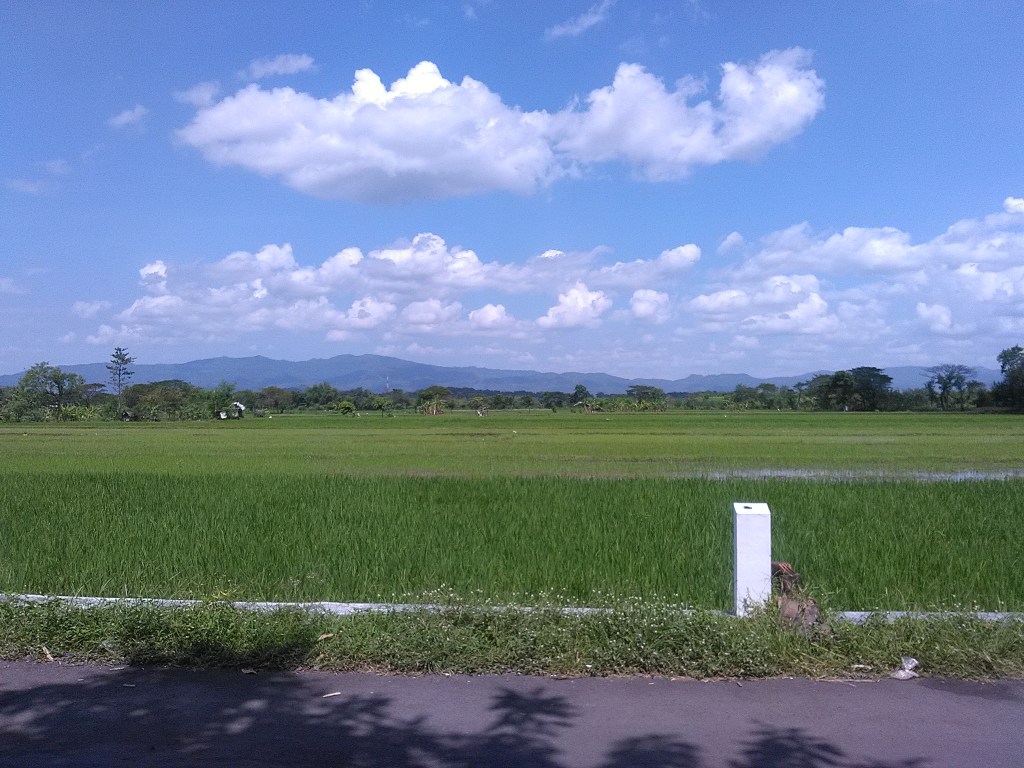
A view across rice fields in one of the villages near Klaten, Java (Dewi Rahma Pratiwi, via Wikimedia Commons: CC BY-SA 4.0).
In the end, Jagus did not make it into my PhD dissertation, which focused on a different aspect of the anti-communist violence in Indonesia. All I could do was write a small blog post about him in 2017, and then move on to another chapter of my life. But in 2021-22, while I was working at the State University of Malang, articles about Jagus accidentally emerged again, brought to me by a few students who knew I had previously written about him. It turns out that Jagus not only featured in the BTI periodical, but also in Javanese magazines and other popular publications. The ghost was still roaming around, at least in my life.
I examined more documents in the Netherlands (Leiden University Library, IISG) and Indonesia (National Archive, National Library, East Java Regional Archive), and through Jagus came to realize three things, which inform my recent JHoK article. First, Jagus brought me to take a closer look at the grassroot figures — peasants, farmers — who contributed to Indonesian agriculture through their innovations, discovered not in research centers, laboratories, or universities, but out in their own fields. Second, I realized that these leftists were also knowledge producers, not only advocators or activists fighting for land reform. Thirdly, I came to appreciate just how close the connection between science and the grassroots movement was in this period in Indonesia, something that no longer exists in the present agricultural movement.
And still the ghost lingers. Last year — and again, quite by chance — I discovered another archive related to Jagus: the examination report of Jagus’s inventions by the Ministry of Agriculture. Important things seem to appear when we are not actually looking for them. And being a historian, I think, is about being flexible, and not letting our present research goal blind us.
Several years after our first encounter in 2017, I was finally able to write an (almost) complete story of BTI’s grassroot scientists in 2026, presented in my JHoK article. Perhaps Jagus is now satisfied that someone has revived their history. Though maybe he wants more, as there still remains much more on the agenda: the accessibility of leftist archives in foreign institutions, inclusivity of the histories of the left in Indonesian historiography, the growing studies of leftist histories by Indonesian researchers, grassroots archiving, and much, much more. Although my article is written by just one individual, writing Indonesian leftist histories is a collective effort — perhaps together with the ghosts.
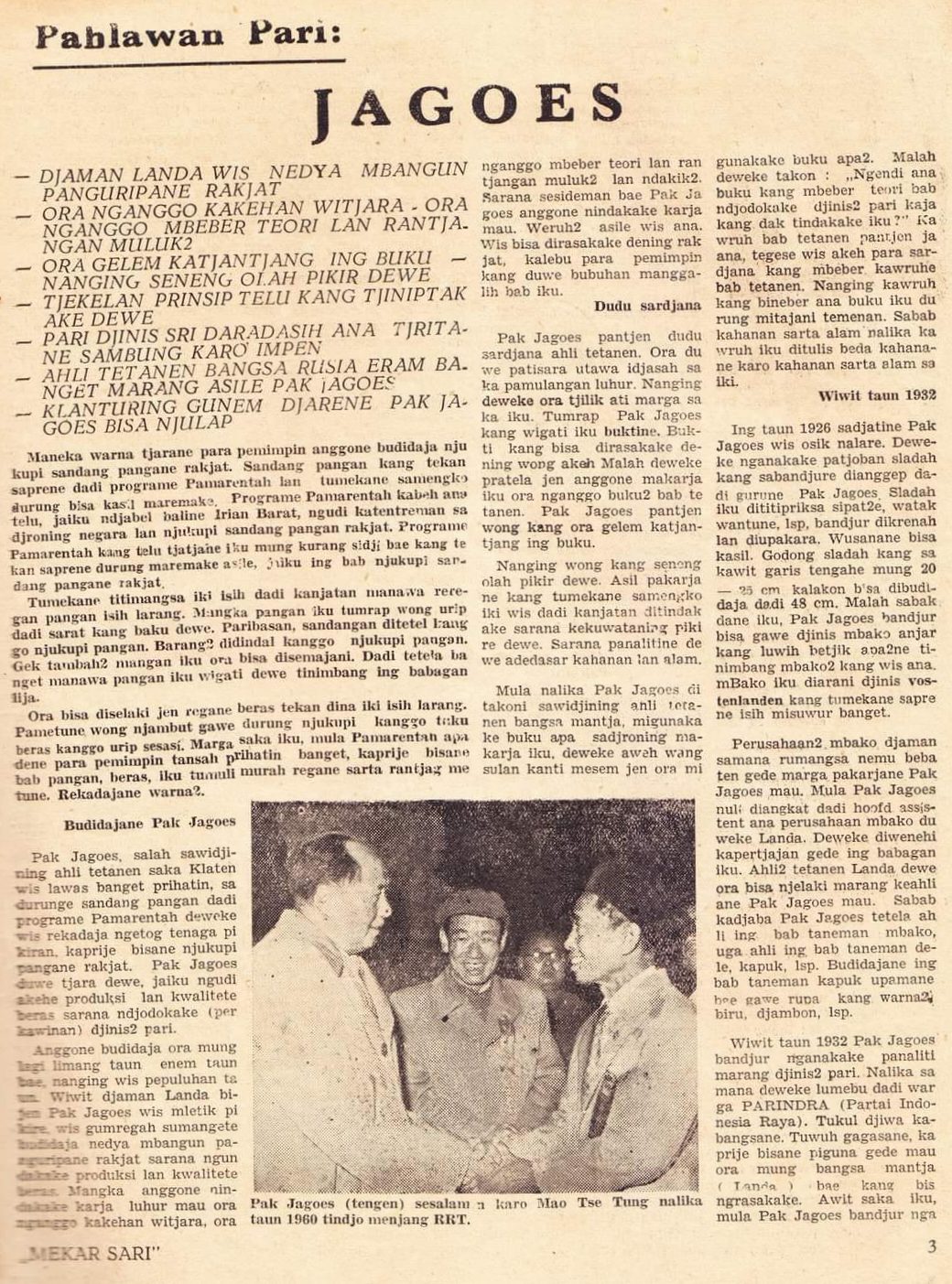
An article about Jagus, the ‘rice hero’, with a picture of him shaking hands with Mao Tse Tung in a 1960 visit to China, published in Javanese magazine Mekar Sari, no. 22, 15 January, 1964. Leiden University Library.
Grace Leksana is an assistant professor in Cultural History at Utrecht University. Her initial work focused on the fields of memory and violence. She is the author of Memory Culture of the Anti-Leftist Violence in Indonesia: Embedded Remembering (Amsterdam University Press, 2023). She is currently investigating the history of ecological knowledge and the cultural politics of food.
Journal for the History of Knowledge



You must be logged in to post a comment.